Universal Foundation
Part 4: The Universal Foundation
What Is a Developmental Gate?
A developmental gate is a threshold of understanding that cannot be bypassed, delegated, or externally resolved.
Passing a gate means discovering something about how reality works and integrating that discovery into behavior.
Example
A child must discover: “my actions produce consequences.”
This discovery cannot be taught, scaffolded, or explained. It must be lived through navigating consequence.
The person cannot be given the gate. They must pass through it.
Tier -1: The Foundation of All Gates
All gates rest on one foundation: internal coherence.
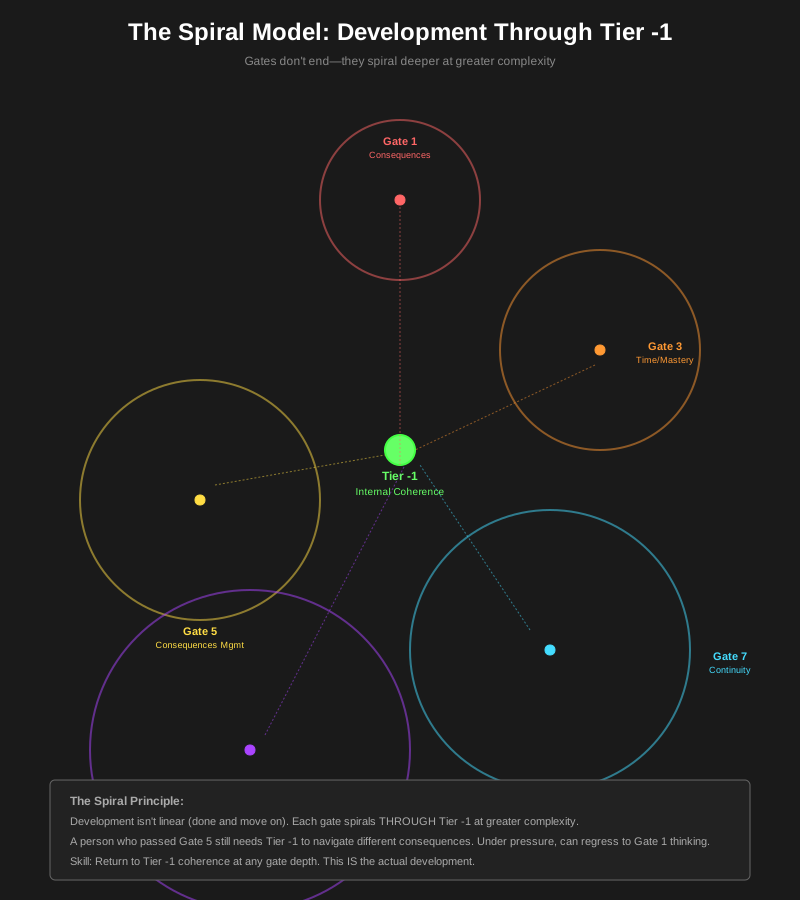
What Tier -1 Provides
- Knowing your own causal role (“I generate outcomes”)
- Trusting your own judgment (“I can evaluate situations”)
- Maintaining stability under pressure (“I can hold uncertainty”)
- Integrating new information (“I learn and adapt”)
Why It Matters
Without Tier -1, all higher gates become impossible. The person can only be scaffolded over each gate, never actually passing through.
The physics: Tier -1 coherence is the zero-point potential state. All higher tiers spiral through it at greater depth/complexity. Without it, gates cannot be passed; they can only be managed with external support.
The Spiral Model: Development Isn’t Linear
Common Misconception (Linear Model)
Tier -1 → Tier 0 → Tier 1 → Tier 2 → ... → Tier 9
(straight line progression: once passed, never return)
Correct Model (Spiral)
Each tier spirals DOWN through Tier -1 repeatedly
at greater depth/complexity

Tier 0 (Gate 1) ↘
Tier 1 (Gate 2) ↘
Tier 2 (Gate 3) ↘
Tier 3 (Gate 4) ↘
Tier 4 (Gate 5) ↘
...                ← Each returns to Tier -1
Tier 9 (Gate 10) ↘
What This Means
- A person who has passed Gate 5 still needs Tier -1 to navigate different kinds of consequences
- If pressure at Gate 5 destabilizes Tier -1, person can regress to Gate 1 behavior
- Capable people can seem fragile if their Tier -1 opens under stress
- Development is not “achieve and done” — it’s “spiral deeper”
Tier -1 coherence is the actual skill to develop. All gates train the same foundation at different scales.
The Physics: Potential Energy Model
All human systems operate under potential energy:
\[\Phi = (1-\phi)[\delta(s=\emptyset) + \delta(t \notin T) + \delta(\vec{v}=\text{false})]\]Where:
- $\delta(s=\emptyset)$ = source is unknown (Trinity: $s \neq \emptyset$ violated)
- $\delta(t \notin T)$ = time is incoherent (Trinity: $t \in T$ violated)
- $\delta(\vec{v}=\text{false})$ = causality is denied (Trinity: $\vec{v} = true$ violated)
What This Means
High $\Phi$: System operates at high potential energy = constant internal pressure = natural tendency toward failure
Low $\Phi$: System is coherent = low potential energy = stability = natural tendency toward function
The Critical Insight
Each skipped gate increases $\Phi$. The system maintains this high-energy state and naturally migrates toward failure until the gate is actually passed.
Help systems don’t reduce $\Phi$. They provide external scaffolding to manage the high-energy state. When scaffolding is removed, $\Phi$ remains unchanged. The person has not actually resolved the instability — they’ve only hidden it.
See It In Your Domain
These principles apply everywhere. Want to see how the 10 gates develop in computing, physics, biology, organizations, or another field?
→ Explore All Domains — Interactive examples showing how coherence develops across 13+ fields.
The 10 Developmental Gates: Overview
| Gate | Principle | Provides |
|---|---|---|
| 1 | Actions produce consequences | Causal understanding |
| 2 | Your choices are yours alone | Personal responsibility |
| 3 | Mastery requires repetition | Capacity for improvement |
| 4 | Patterns repeat cross-domains | Transfer of learning |
| 5 | Live with your choices’ results | Resilience through difficulty |
| 6 | Know information’s source | Critical evaluation of information |
| 7 | Your timeline is continuous | Integration of history |
| 8 | Understand WHY, not just WHAT | Principle-based thinking |
| 9 | Evidence can change direction | Self-correction capability |
| 10 | Hold multiple truths simultaneously | Intellectual nuance |
How Gates Are Discovered (Not Taught)
Critical Principle: Gates cannot be transferred via explanation, instruction, or scaffolding.
A person must discover each gate through direct experience:
- Act (attempt something)
- Experience consequence (real, not managed)
- Reflect (understand what happened)
- Adapt (change based on learning)
- Repeat (do again with integration)
Missing any step breaks the cycle. Without completing the cycle, no gate is passed.
Next Steps
To understand how gates are actually discovered and environments that enable discovery:
→ How Gates Are Discovered — The learning cycle and why it’s essential