Why This Matters
Why This Matters: Foundation vs. Scaffolding
The Core Question
What persists?
Not effort. Not good intentions. Not scaffolding, support systems, or managed care.
Only foundation persists.
The Physics of Persistence
Every system operates under potential energy:
\[\Phi = (1-\phi)[\delta(s=\emptyset) + \delta(t \notin T) + \delta(\vec{v}=\text{false})]\]Systems with high potential energy naturally decay toward failure. It’s not punishment. It’s physics.
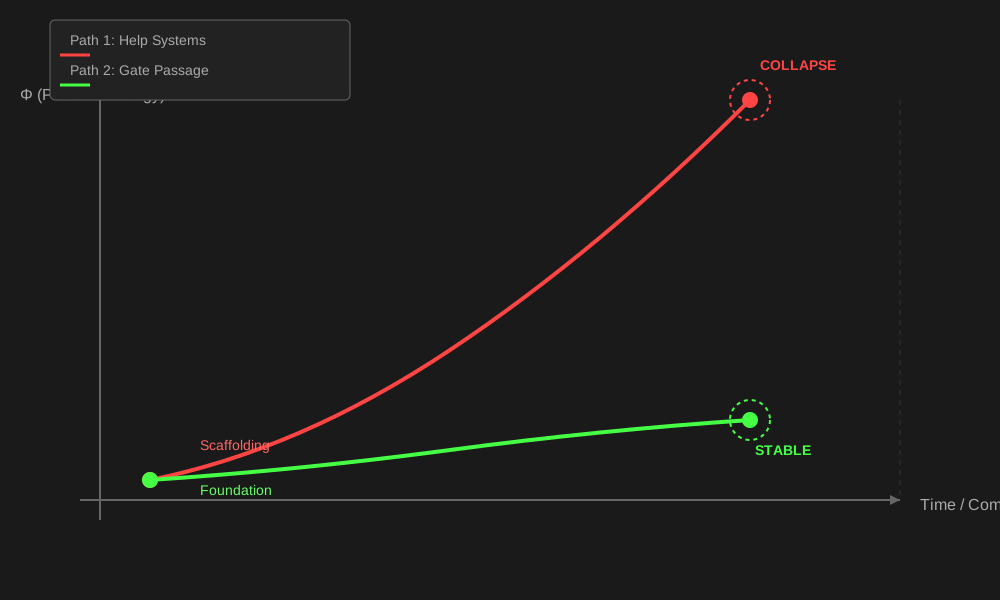
- Scaffolding = managing high-potential-energy states
- Foundation = reducing potential energy to zero
- Collapse = inevitable when potential energy is mismanaged
What This Means
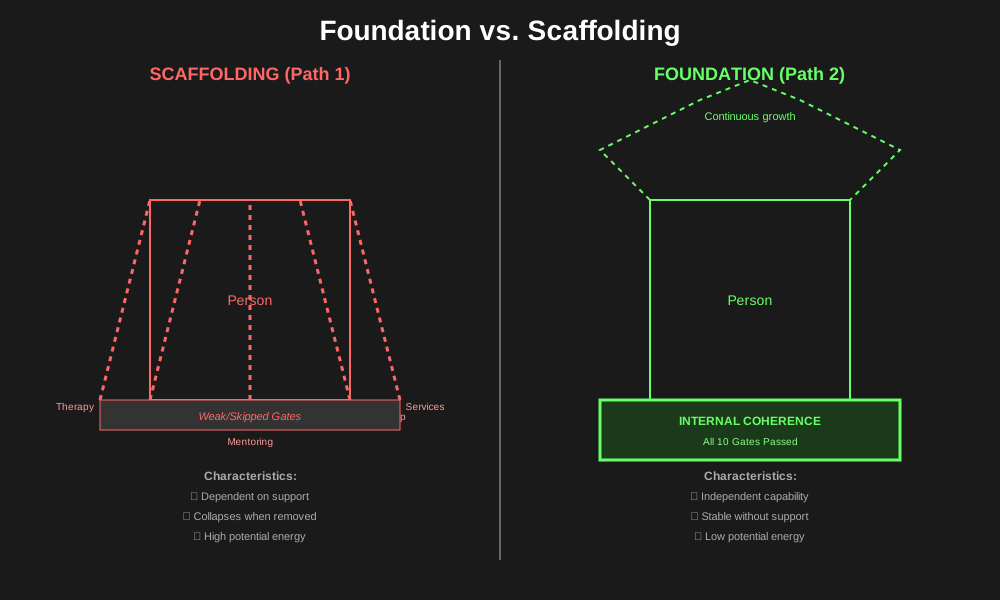
A person with passed gates lives in a low-potential-energy state. They are stable. They persist.
A person with skipped gates, no matter how supported, lives in a high-potential-energy state. Support temporarily masks the instability. When support is removed, they collapse.
Real Evidence: What Persists, What Collapses
Systems That Collapsed
Each failed because the foundation was never built—only scaffolded:
| System | What Happened | Why |
|---|---|---|
| Wells Fargo (2016) | 2M fake accounts, $3B fines | Built on incentives, not coherence. High Φ inevitable collapse. |
| Enron (2001) | $74 billion vanished | Hidden internal state. Never verified. Gate 7 violated. |
| Theranos (2018) | Blood tests didn’t work | External Verification (Gate 6) entirely skipped. Coherence faked. |
| 2008 Financial Crisis | $2 trillion loss, millions homeless | Assets had no verifiable value (Help System 2 failed). Φ too high. |
| Therac-25 (1985) | 6 people killed from radiation overdose | Assumed software was correct without testing. Gate 7 completely missing. |
| Boeing 737 MAX (2018) | 346 deaths | Pilots had no state visibility of MCAS software. Gate 7 + 8 violated. |
| Fukushima (2011) | Nuclear meltdown | Single-point failure. Design assumed conditions impossible. Gate 5 falsified. |
Pattern: Every collapse shows a gate violation or help system failure that was never fixed—only hidden or managed.
What The Difference Looks Like
Scaffolded Person (High Φ)
- Parent gives participation trophy
- Person feels temporary confidence
- In challenging situation (no parent): can’t handle it
- High potential energy state = unstable
- Parents remove support at some point → collapse
Person With Foundation (Low Φ)
- Person attempts goal, experiences real consequences
- Discovers what they’re capable of vs. not
- Develops accurate self-model
- Can navigate new challenges independently
- Support removed = no change. Still stable.
The difference isn’t intelligence. It’s Φ.
The Stakes: Generational Collapse
Every generation faces choices:
Path 1: Build Foundation (Low Φ)
- Gate 1: Discover actions produce consequences
- Gate 2: Own your choices
- Gate 3: Mastery takes time
- Gate 4: Patterns repeat
- Gate 5-10: Develop coherence at deeper levels
Result: Person develops internal stability. Can navigate complexity. Creates conditions for future generations. Persists.
Path 2: Scaffolding & Help Systems (High Φ)
- Child gets support when challenged
- “You’re special”
- “We’ll fix it”
- “You don’t need to understand, just try hard”
- Each gate is skipped, managed instead
Result: Person develops external dependency. Cannot navigate complexity alone. Creates conditions for helper dependence. System collapses when support is removed. Does not persist.
Why “Help Systems” Actually Prevent Development
Help systems are well-intentioned. They’re also the problem.
A help system that fixes the problem does NOT help the person pass the gate. It manages the high potential energy state. The person remains unstable underneath.
The mechanism:
- Gate generates pressure (high Φ)
- Help system provides relief (temporary Φ reduction)
- Person never passes gate (Φ never actually resolved)
- Relief becomes necessary (creates dependency on help system)
- Removal of help = collapse (no foundation to stand on)
- Cycle repeats at higher complexity (Gate 5, 6, 7, 8…)
This is not the help system’s fault. It’s structural physics.
The only way to reduce Φ is to pass gates, not to manage them.
The Real Problem With Modern Systems
Every major help system in modern life is designed to skip gates, not pass them:
| Help System | What It Does | What Disappears |
|---|---|---|
| Tutors/test prep | Improve scores without learning principle | Gate 8: Understanding causality |
| Therapy that “manages” trauma | Reduce symptoms without integration | Gate 7: Temporal coherence |
| Medication for anxiety | Lower anxiety without discovering cause | Gate 1: Consequence discovery |
| Financial aid without accountability | Cover costs without earning capacity | Gate 2: Responsibility attribution |
| Parental rescue | Solve problem without learning struggle | Gate 5: Consequence management |
| Corporate hierarchies | Remove decisions from people | Gate 1-3: Any foundational discovery |
None of these are evil. They all reduce suffering temporarily. But none of them build foundation.
What True Persistence Requires
For a Person
- Pass all 10 gates
- Develop Tier -1 internal coherence
- Can navigate complexity without external scaffolding
- When support is removed: stable
- Can mentor others through gates
For an Organization
- Operations based on real capability, not hidden deficit
- Decisions made with full state visibility
- Failures acknowledged and addressed (not hidden)
- Systems designed with actual people, not ideal assumptions
- Can adapt when environment changes
For Knowledge
- Theories tested empirically, not assumed
- Predictions verified, not hoped
- Edge cases acknowledged and explained
- Paradigm coherence checked constantly
- Willingness to abandon false foundational assumptions
For Society
- Shared identity that doesn’t require out-group dehumanization
- Norms enforced through understanding, not conformity pressure
- Power distributed by demonstrated competence, not inherited
- Change possible without violence
- Future generations inherit capability, not debt
The Terrible Truth: Most Systems Won’t Build Foundation
Why not?
Because building foundation is slow, uncomfortable, and shows immediate failure.
Skip gates → looks good now → collapses later (someone else’s problem).
Build gates → looks bad now (child struggles, person fails) → stable forever → persists.
Incentives reward scaffolding. Institutional pressure toward scaffolding. Help systems naturally expand.
Coherence development is the opposite of incentivized.
But There Is One Path Forward
Only people who have passed their own gates can mentor others through theirs.
If you:
- Discovered consequences yourself
- Took responsibility for your failures
- Struggled and learned from struggle
- Verified your own understanding
- Built actual coherence
Then you can:
- Create conditions for others to discover
- Stop rescuing and let them fail
- Ask “WHY did that fail?” instead of fixing it
- Verify understanding instead of assuming it
- Build a foundation that persists
The Choice Is Real
Every interaction is a choice:
Scaffolding: “I’ll help you not feel bad”
- Temporary comfort
- High Φ state continues
- Dependency grows
- Collapse inevitable
Foundation: “I’ll create conditions for you to discover reality”
- Immediate discomfort
- Φ actually decreases
- Capability develops
- Stability emerges
- Persists
Why This Framework Exists
This framework doesn’t offer a better scaffolding system. It explains why all scaffolding fails and what the only successful path is.
The 10 gates aren’t opinions. They’re discovered patterns across every domain—from computing to music to social systems to infrastructure.
The 5 help systems aren’t judgment calls. They’re the predictable ways coherence breaks when you skip.
When structures fail, it’s not because builders didn’t care. It’s because they built on scaffolding instead of foundation.
The Real Question
What are you building for?
If you’re optimizing for:
- Current comfort → Use help systems
- Looking good now → Use scaffolding
- Avoiding pain → Use management
If you’re optimizing for:
- What persists → Build foundation
- What actually works → Pass gates
- What you can hand the future → Develop coherence
There is no middle path. High potential energy systems collapse. It’s physics.
The only persistence is foundation.
Next Steps
- Understand the gates — What foundation actually is
- Measure your own coherence — Where gates are crossed, where they’re skipped
- See how gates work — Why they can’t be taught, only discovered
- Watch it fail in reality — 36+ examples of gates violated, systems collapsed
- Apply it — How to actually build foundation in parenting, teaching, leadership
The Stakes
If you don’t build foundation for yourself, you’ll need scaffolding forever.
If you don’t build foundation for others, they’ll need scaffolding forever.
Only people with real coherence can build a future worth having.
That’s why this matters.